

2025-10-02 | General
Happy Mid-Autumn Festival
Dear Valued Customers,On this Mid-Autumn Festival, we wish you joy, peace, and prosperity. Thank you for your continued trust and support.Please note that our o
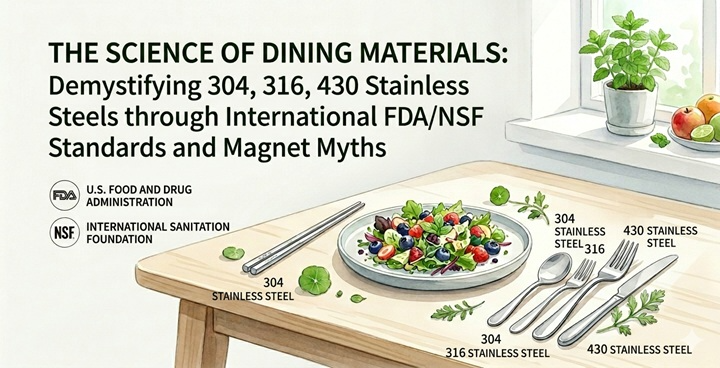
Recent investigations into the fraudulent substitution of 200 series stainless steel for 300 series (such as SUS304) in tableware have sparked public concern. However, "stainless steel" is not a uniform material; international standards govern chemical composition and sanitation certifications for food-contact metals. As an industry consultant, Sun Chun Stainless Steel provides a technical analysis of these regulatory boundaries.
According to technical specifications from Yieh United Steel Corporation (YUSCO) and the International Stainless Steel Forum (ISSF), the core distinctions lie in their alloying elements:
Chemical Composition (The Substitution of Nickel with Manganese):
Corrosion Behavior:
The passive layer of 200 series steel degrades rapidly when exposed to weak acids and chloride ions (salt) found in food, leading to pitting corrosion and increasing the risk of manganese leaching into dietary sources.
Following recent food safety news, a common rumor claims that "using a magnet to test tableware can identify counterfeits if it sticks." In reality, this is a severe misunderstanding of metallurgical microstructures and ignores the legitimate use of 430 steel.
SUS430 contains 16% to 18% Chromium (Cr) and 0% Nickel (Ni). Because its Chromium content fully complies with the international food safety threshold of greater than 16%, 430 is a completely legal, safe, and highly popular material for tableware. It is widely used for western cutlery (knives and forks), stirring spoons, and the outermost layer of multi-ply cookware—where its strong magnetic induction is essential for compatibility with induction cooktops.
International regulatory bodies certify the finished food-contact product, its formulation, and its surface execution. The two definitive global benchmarks are:
While the magnetic properties of stainless steel change with manufacturing processes or alloy families, the chemical integrity remains unaltered. SUS430 is an excellent, cost-effective food-grade option for cutlery and induction cookware bases. However, for containers intended for long-term storage of highly acidic or saline foods, we recommend prioritizing SUS304 or SUS316L due to their superior pitting resistance.
At Sun Chun Stainless Steel, we urge commercial food processing manufacturers to source materials paired with legitimate Mill Certificates from trusted mills. Aligning with the rigorous criteria of FDA and NSF frameworks is the only way to safeguard consumer health and secure long-term corporate reputation.
參考資料 (References)
Yieh United Steel Corporation (YUSCO): Austenitic & Ferritic Stainless Steel Specifications
International Stainless Steel Forum (ISSF): The Stainless Steel Family - Ferritic & Austenitic Grades
JFE Steel Corporation: Ferritic Stainless Steel Technical Sheets
U.S. Food and Drug Administration (FDA): 21 CFR Food Zone Material Guidelines
NSF International: NSF/ANSI 51: Food Equipment Materials
About Sun Chun Stainless Co., Ltd.
Established in 1994, Sun Chun Stainless Co., Ltd. has stood as a trusted vanguard in the stainless steel sector for over three decades. Operating out of Taiwan, we excel in the raw material distribution and custom processing of an extensive portfolio of high-grade stainless steel coils, sheets, and strips. Our advanced facility features specialized, fully integrated machinery including a 5 FEET SLITTING LINE, 800mm & 5 FEET FLY-SHEAR CUT-TO-LENGTH LINES, and our flagship 5 FEET FULLY OIL PROCESS POLISHING LINE. Certified under ISO 9001 and ISO 14001 international standards, Sun Chun combines uncompromising quality control with seasoned human expertise, serving as your premier supply chain partner to enhance market competitiveness.
